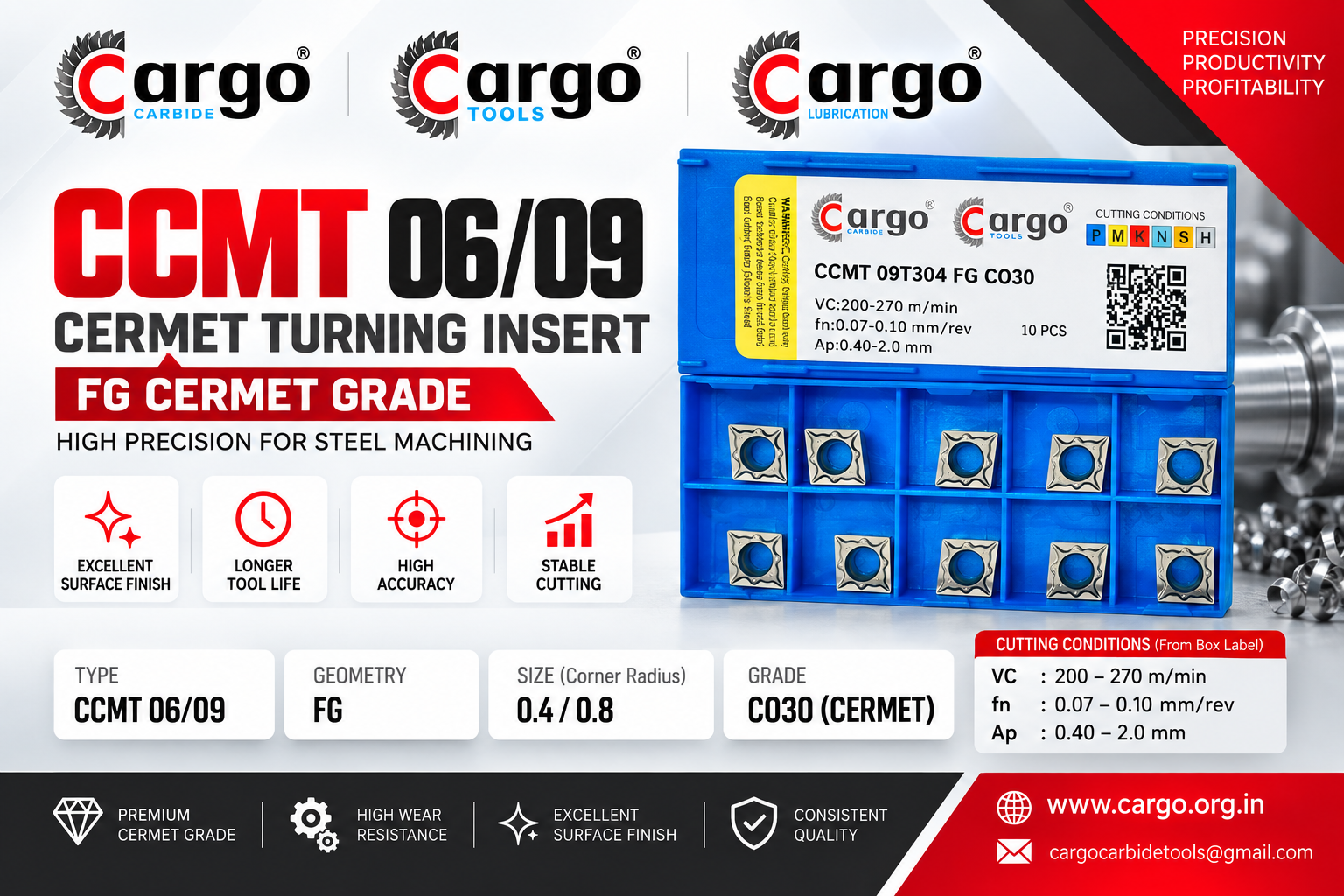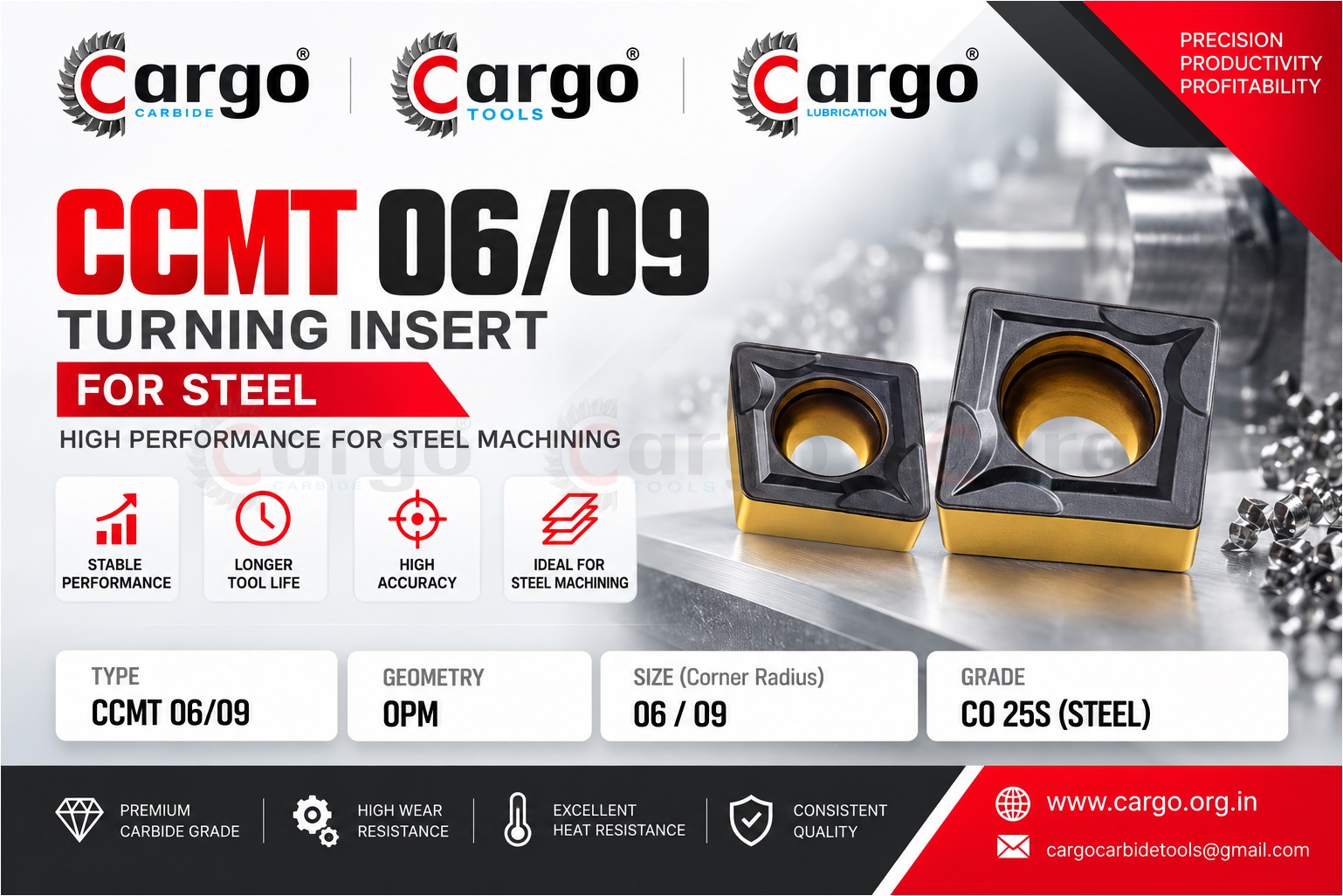

Cargo Carbide CCMT for Steel is a carbide turning insert intended for CNC machining of steel components in general production and precision turning applications. The CCMT format is well suited to compact turning tools where the cutting edge needs to reach shoulders, smaller diameters and other detailed areas of a component.
For steel machining, this insert can be used across common turning operations such as diameter reduction, facing, profiling and finishing. Its indexable construction allows a worn cutting edge to be changed by indexing or replacing the insert rather than replacing the complete tool assembly.
The final insert grade and cutting conditions should be selected according to the steel type, component geometry and machining requirement. Proper selection of cutting speed, feed, depth of cut and coolant can help maintain stable machining and predictable insert wear.
| Specification | Details |
|---|---|
| Brand | Cargo Carbide |
| Product Type | Carbide Turning Insert |
| Insert Code | CCMT |
| Application | Steel Machining |
| Workpiece Material | Steel |
| Insert Construction | Indexable Carbide |
| Geometry | CCMT |
| Machine | CNC Lathe / CNC Turning Center |
| Operations | Turning, Facing, Profiling & Finishing |
| Holder Compatibility | CCMT Tool Holder |
| Application Category | Steel Turning |
A CCMT steel insert is an indexable carbide turning insert used for machining steel components on CNC lathes and turning centers. The suitable carbide grade depends on the steel being machined and the cutting conditions.
A CCMT steel insert can be used for operations such as external turning, facing, shoulder machining, profiling, semi-finishing and finishing.
Yes. CCMT inserts can be used for CNC machining of steel shafts and similar cylindrical components when the insert grade, holder and cutting parameters are appropriate for the application.
The insert should be mounted in a compatible CCMT tool holder. The holder specification must correspond to the particular CCMT insert and machine setup.
Consider the steel grade, cutting operation, depth of cut, feed rate, cutting speed, component geometry and required surface finish. The carbide grade should be selected to match the machining condition rather than using one grade for every steel application.